
Manual Stitches
Underlay and pull compensation
How the hidden first layer works, which underlay to pick, and how to stop shapes shrinking.
Underlay#
Underlay is the layer of light stitches sewn before the visible ones. Read the idea first in Stitch terms.
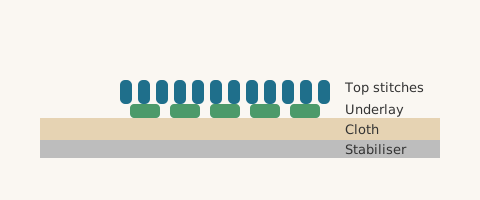
Satin underlay choices#
Pick one from the Underlay list in the Satin section.
| Choice | What it is | Use for |
|---|---|---|
| None | No underlay | Very thin columns, or when you add your own |
| Center run | One line down the middle | Columns under about 2.5 mm |
| Contour | A line right inside each edge | Medium columns |
| Zig-zag | Back-and-forth across the column | Wider columns |
| Contour + zig-zag | Edge walk plus zig-zag | Wide columns on soft cloth |
| Center + contour | Middle line plus edge walk | Columns of about 2.5 to 4 mm |
| Double zig-zag | Two zig-zag passes | Columns wider than about 6 mm |
When Lilo digitizes for you it picks one by width: centre run under 2.5 mm, centre plus edge up to 4 mm, edge plus zig-zag up to 6 mm, and double zig-zag beyond that. You can change it.
Fill underlay#
In the Underlay section of a fill:
- The Underlay switch adds one light pass at right angles to the fill.
- Customise underlays… lets you add several passes. Each has an Angle, Spacing, Length and Inset. Inset is how far inside the edge the underlay stops, so it stays hidden.
- Open patterns (motifs, crosshatch) skip the automatic underlay, because it would show through the gaps.
Heavy fills on soft cloth benefit from two passes at different angles.
Pull compensation#
Thread pulls cloth inward, so stitched shapes come out smaller than you drew. Pull compensation makes the shape a little bigger on purpose.
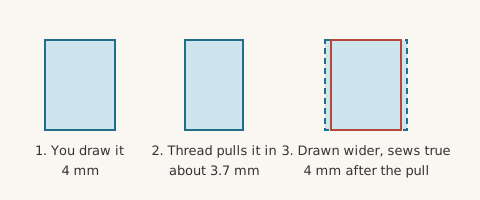
- Satin columns: widens each side. 0.15 mm per side is the Standard starting value. Premium uses 0.20 mm. The slider goes up to 0.8 mm.
- Fills: grows the shape. The slider goes up to 1 mm.
Stretchy cloth pulls more. Lilo's Sewing setup raises compensation for knits to about 1.8 times the woven value.
How to tell if you need more#
Sew a test. If a 4 mm column measures 3.7 mm, or if the outline of a fill sits inside its border, raise pull compensation. If it looks fatter than your drawing or it overlaps its neighbours, lower it.